Cap Casualties: The NFL Contracts That Are Quietly Destroying Teams From the Inside Out
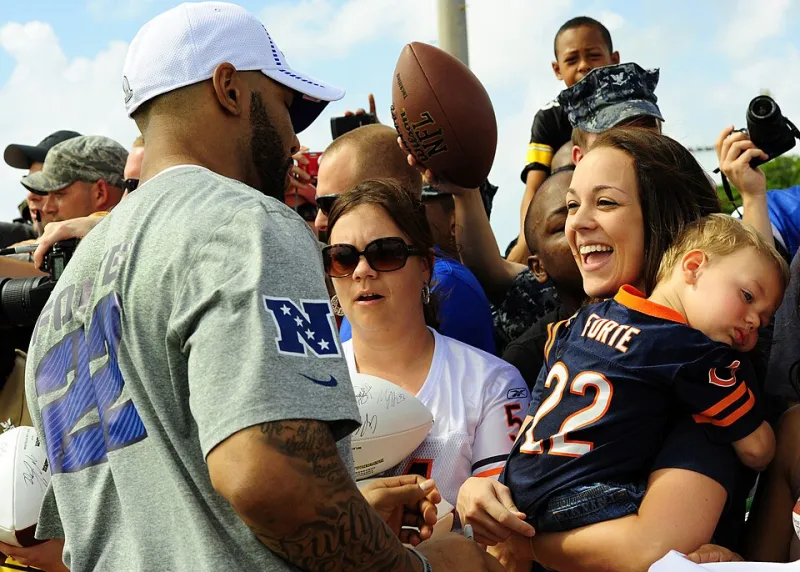
Photo: Official Navy Page from United States of America John M. Hageman/U.S. Navy, Public domain, via Wikimedia Commons
Let's be real for a second. The NFL salary cap is a zero-sum game. Every dollar locked into a player who isn't producing is a dollar that could've gone toward a pass rusher, a cornerback, or literally anyone helping your team win football games. Front offices know this. Agents know this. And yet, every offseason, we watch teams hand out contracts that make you tilt your head like a confused golden retriever.
This isn't about hating on the players. Getting paid is the goal. If someone's willing to write you a nine-figure check, you take it. No questions asked. This is about the organizations — the GMs, the cap analysts, the ownership groups — who looked at the production data, looked at the injury history, looked at the age curve, and still said, "Yeah, let's guarantee $80 million to this guy." That's on them.
So let's get into it.
The Quarterback Tax Gone Wrong
Quarterback contracts have always carried a premium. That's just the market. But there's a difference between paying for elite production and paying for the memory of elite production.
Take a look at several current starting quarterbacks who are eating up north of $45 million per year in cap space while sitting comfortably in the bottom half of the league in QBR, yards per attempt, and — most critically — wins. When your franchise QB is costing you nearly 20% of the entire salary cap and you're picking in the top ten, something went sideways in the negotiation room.
The pattern is almost always the same. A player has one or two breakout seasons, hits the market or demands an extension, and the front office — terrified of losing "their guy" — overpays based on ceiling rather than floor. The problem? NFL careers live on the floor. The ceiling is a highlight reel. The floor is what shows up in January.
The Pass Rusher Problem
Edge rushers are the second-most expensive commodity in the league, and the drop-off between a legitimate difference-maker and an expensive liability is steeper than most front offices want to admit.
Right now, there are at least two or three edge defenders collecting checks in the $22-28 million annual range who haven't sniffed double-digit sacks in two-plus seasons. One of them missed significant time last year. Another has been quietly benched in critical late-game situations — which, if you're paying a guy to wreck opposing offenses, is about the most damning indictment a coaching staff can hand down without actually saying anything.
The issue with pass rusher contracts specifically is the injury risk. These guys take an absolute beating every single game. Offensive linemen are getting bigger, smarter, and more technically refined every year. The idea that a 29-year-old edge rusher is going to maintain the same burst and bend that made him worth a massive deal at 26 is optimistic at best and delusional at worst.
Wide Receivers Cashing Checks Their Routes Can't Cover
The receiver market exploded over the last few years, and some teams got caught chasing the wave. Not every guy who posts 1,100 yards in a contract year is a true number-one receiver. Some of them were number twos playing in a number-one role because the offense around them created favorable matchups. Pay that guy like a true alpha and suddenly the matchups aren't so favorable anymore.
A handful of current wideouts sitting on deals worth $25 million or more annually are averaging fewer than six targets per game, running limited route trees, and — here's the one that really stings — posting drop rates that would embarrass a college freshman. When you're that expensive and that unreliable, you're not just underperforming. You're actively hurting your team's ability to build around you.
The Offensive Line Miscalculation
Protecting your quarterback is everything. We all know this. But not every offensive lineman who plays well in a system translates when the money gets real and the expectations go up.
There's a specific type of lineman — usually a guard or center — who thrives in a zone-blocking scheme, gets paid like a franchise cornerstone, and then struggles enormously when the team shifts philosophies or the surrounding talent changes. These guys aren't frauds. They're just scheme-dependent players being paid like scheme-independent ones. That's a front office evaluation failure, not a character flaw.
Right now, at least two interior linemen are collecting checks in the $16-20 million range while their quarterbacks are getting hit at rates that should embarrass everyone involved in that contract negotiation.
The Defensive Back Graveyard
Cornerstacks and safeties are notoriously difficult to evaluate long-term. The athleticism that makes a defensive back elite in his mid-twenties starts eroding fast, and the league is constantly finding new ways to scheme guys into bad positions.
Several teams are currently paying cornerbacks in the $19-23 million range who are getting torched on a weekly basis. One of them hasn't had a legitimate pass breakup in what feels like a full calendar year. Another has been quietly moved to a less demanding coverage role — which is the NFL's version of telling someone they've been reassigned to a broom closet.
What All These Deals Have in Common
Here's the through line. Every single one of these contracts shares a few DNA markers. First, they were signed during a moment of organizational desperation — either a team trying to signal competitiveness or a front office terrified of the alternative. Second, they were based on recent peak performance rather than sustainable production. Third, there was almost certainly internal dissent that got overruled by ownership or a head coach with too much roster control.
The NFL is a copycat league in more ways than one. When one team overpays at a position, others panic and follow. The receiver market explodes, so everyone overpays for receivers. The edge rusher market spikes, so everyone opens the vault for pass rushers. It's herd mentality with billion-dollar consequences.
The Bottom Line
None of this means these players are bad at football. Most of them are genuinely talented. The problem is that talent has a price, and when the price exceeds the value delivered — week after week, season after season — it becomes a competitive anchor dragging entire franchises underwater.
The teams that consistently win in the NFL are the ones that find value, develop it, and pay it correctly. The teams handing out the contracts on this list? They're learning that lesson the hard way, one cap casualty at a time.
And somewhere, a GM is already drawing up the next bad deal. The cycle never stops.